
Deep breath. Here we go.
I’m a very confident person, and an outsider looking at me would think that I am totally confident and perhaps a little too confident? Either way, strangers, family and friends alike all have this perception of me that I love the way I am and the way I look. And it’s true, for the most part at least.
I have never had the healthiest relationship with my body, my weight, and the way I look in the mirror, and a portion of that was because of simple genetics. For those just tuning into Widow’s Lure, I’m biracial but predominantly Pacific Islander; I don’t have the exact ratios for you, but ethnicity-wise, I’m Māori, Samoan and Irish. And if you have never met a Polynesian person in your life, let me tell you from personal experience that because of how our genetics work, we are generally speaking a lot larger than other races, and we typically have the ability to grow muscle, put on weight and get bigger a lot easier than others.
Growing up in Australia and being exposed to western culture where all the advertisements showed conventionally attractive white folk who were either thin or ripped, at any stage of my life, I knew that my body did not look like that; dare I say I never had “the look”. I was always on the bigger side in both primary and high school, and even past my teenage years as I entered the workforce and studied at uni, I was still on the bigger side.
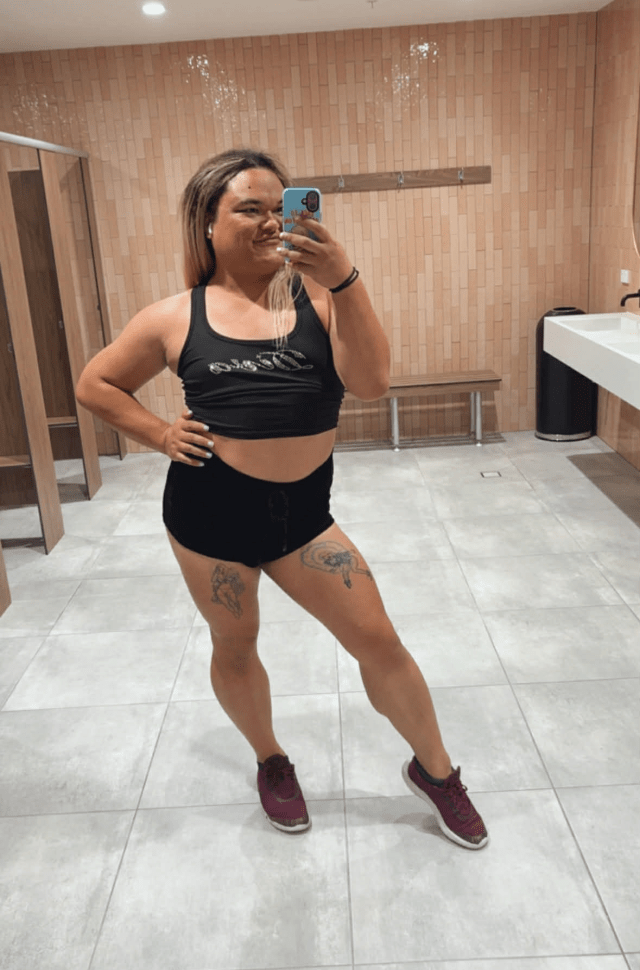
Learning to love the way my body looks has been a journey.
In 2017, when I first started wrestling training, I was still on the bigger side with not that much muscle mass. But then as I progressed with my training, I remember locking tf in and I ended up dropping over 15kgs, slimming and toning down, and being in really good shape. But because I was sitting at 90kgs, which is still considered quite heavy compared to other wrestlers in Australia, I still wasn’t happy with how I looked solely because of the number on the scales. Even though the mirror showed me a physically fit human and I could see the progress I was making through the gym and nutrition, I was still not happy with how I looked.
So I decided to bulk up and see if that would change how I looked at myself in the mirror. And because of bad habits, poor nutrition, and a general slothfulness, the bulk went the wrong way and I essentially put all the weight I had lost back on, and not in a good muscular way either. So I became even unhappier with the way I looked, especially considering the skimpy outfits I wore as Nikki Van Blair.
No matter how much I worked out and tried to eat better, my body still looked too big and not the right shape. But at the same time, I still had to convey the sexy, sassy and confident Nikki Van Blair that everyone had become accustomed to, so the skimpy outfits stayed but my perception of my body worsened. I point blank refused to weigh myself and steered away from scales, and was very selective of what kind of content I’d post on social media; content that suited the Nikki Van Blair brand but also hid parts of my body I was ashamed of through angles, clothing and poses.
At some point, I found myself annoyed at my genetics. I’d see wrestlers of other races either drop weight quickly or put on muscle quickly; even on top of that, just the wrestlers who were naturally smaller than me, I found myself envying them because why on earth could I not just effortlessly look like that.
Around 2022, I began to focus on what I was putting in my body and building muscle. I focused on my protein intake, followed a fairly solid gym workout routine and made sure I did some form of exercise (wrestling training included!) at least five days a week. I thought I was making solid progress because I could see my muscle development in the mirror… and then I weighed myself. I was officially the heaviest I’d ever been.
How on earth did I commit all this effort to bettering my health and my body and my scales are telling me that it was all in vain?
I know that muscle weighs more than fat – or to be more accurate, muscle is more dense than fat – and so a contributor to the numbers on the scales could be muscle gain, but to me, the numbers on the scale tell the full story. As a woman, especially a transwoman, being heavy is so humiliating and contributes to a dysphoria that didn’t need any further contribution to it. Like, how could a woman possibly weigh ___ kgs?
And as my fitness regime continued, and I followed a scheduled workout and included more daily steps and even reformer pilates into my routine, my weight would either stay stagnant or would go up even incrementally. I began enjoying for the most part of what I saw in the mirror, but the numbers on the scales destroyed my confidence.
And then I got a full body Evolt scan, and I finally had all of the numbers explained to me in a way that I understood. Turns out, I’m actually a lot healthier and fitter than I thought, and most importantly… my biological age is 27.
Understanding the actual science and numbers of my body helped my body dysmorphia a lot because now I recognise what’s happening inside my body and clock why the numbers are the way they are. Because of this, I have an appreciation for my Polynesian genetics and the relative ease I have to gain muscle. I might not be screaming my weight out loud because the numbers on the scale will always hold an unfortunate significance to me, but I am proud of the curvy muscular body I’ve worked hard to achieve. And now with the science behind me, I can look in the mirror and be happy with what I see. Now I just need to stay consistent and work hard to maintain this Jessica Rabbit figure of mine, especially since I’m 33-years-old.
Wait sorry. I’m 27.
– by The Black Widow

