Body Dysmorphia as a Polynesian Pro-Wrestler

Deep breath. Here we go.

I’m a very confident person, and an outsider looking at me would think that I am totally confident and perhaps a little too confident? Either way, strangers, family and friends alike all have this perception of me that I love the way I am and the way I look. And it’s true, for the most part at least.

I have never had the healthiest relationship with my body, my weight, and the way I look in the mirror, and a portion of that was because of simple genetics. For those just tuning into Widow’s Lure, I’m biracial but predominantly Pacific Islander; I don’t have the exact ratios for you, but ethnicity-wise, I’m Māori, Samoan and Irish. And if you have never met a Polynesian person in your life, let me tell you from personal experience that because of how our genetics work, we are generally speaking a lot larger than other races, and we typically have the ability to grow muscle, put on weight and get bigger a lot easier than others.

Growing up in Australia and being exposed to western culture where all the advertisements showed conventionally attractive white folk who were either thin or ripped, at any stage of my life, I knew that my body did not look like that; dare I say I never had “the look”. I was always on the bigger side in both primary and high school, and even past my teenage years as I entered the workforce and studied at uni, I was still on the bigger side.
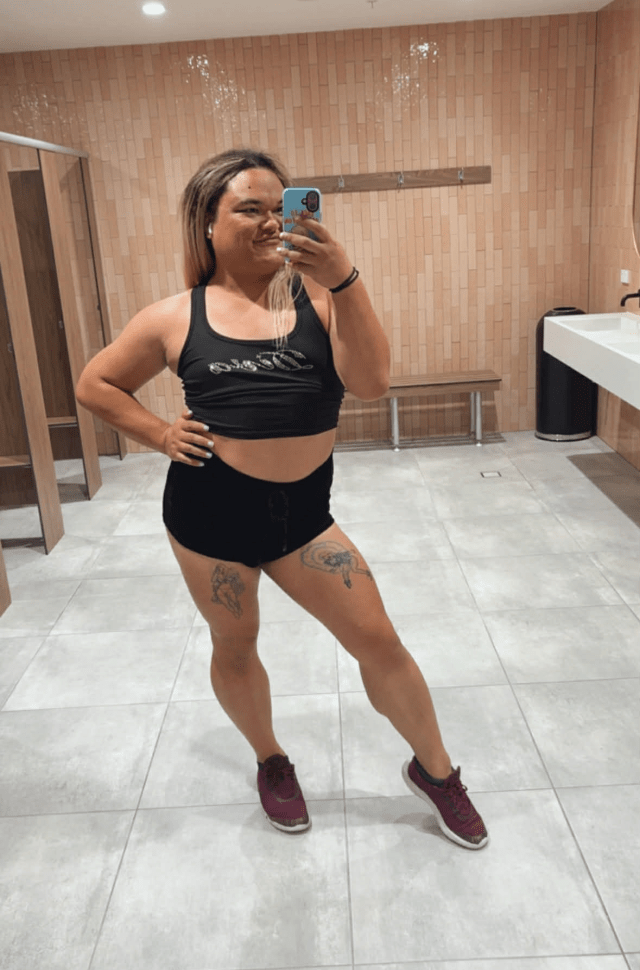
Learning to love the way my body looks has been a journey.

In 2017, when I first started wrestling training, I was still on the bigger side with not that much muscle mass. But then as I progressed with my training, I remember locking tf in and I ended up dropping over 15kgs, slimming and toning down, and being in really good shape. But because I was sitting at 90kgs, which is still considered quite heavy compared to other wrestlers in Australia, I still wasn’t happy with how I looked solely because of the number on the scales. Even though the mirror showed me a physically fit human and I could see the progress I was making through the gym and nutrition, I was still not happy with how I looked.

So I decided to bulk up and see if that would change how I looked at myself in the mirror. And because of bad habits, poor nutrition, and a general slothfulness, the bulk went the wrong way and I essentially put all the weight I had lost back on, and not in a good muscular way either. So I became even unhappier with the way I looked, especially considering the skimpy outfits I wore as Nikki Van Blair.

No matter how much I worked out and tried to eat better, my body still looked too big and not the right shape. But at the same time, I still had to convey the sexy, sassy and confident Nikki Van Blair that everyone had become accustomed to, so the skimpy outfits stayed but my perception of my body worsened. I point blank refused to weigh myself and steered away from scales, and was very selective of what kind of content I’d post on social media; content that suited the Nikki Van Blair brand but also hid parts of my body I was ashamed of through angles, clothing and poses.

At some point, I found myself annoyed at my genetics. I’d see wrestlers of other races either drop weight quickly or put on muscle quickly; even on top of that, just the wrestlers who were naturally smaller than me, I found myself envying them because why on earth could I not just effortlessly look like that.

Around 2022, I began to focus on what I was putting in my body and building muscle. I focused on my protein intake, followed a fairly solid gym workout routine and made sure I did some form of exercise (wrestling training included!) at least five days a week. I thought I was making solid progress because I could see my muscle development in the mirror… and then I weighed myself. I was officially the heaviest I’d ever been.

How on earth did I commit all this effort to bettering my health and my body and my scales are telling me that it was all in vain?

I know that muscle weighs more than fat – or to be more accurate, muscle is more dense than fat – and so a contributor to the numbers on the scales could be muscle gain, but to me, the numbers on the scale tell the full story. As a woman, especially a transwoman, being heavy is so humiliating and contributes to a dysphoria that didn’t need any further contribution to it. Like, how could a woman possibly weigh ___ kgs?

And as my fitness regime continued, and I followed a scheduled workout and included more daily steps and even reformer pilates into my routine, my weight would either stay stagnant or would go up even incrementally. I began enjoying for the most part of what I saw in the mirror, but the numbers on the scales destroyed my confidence.

And then I got a full body Evolt scan, and I finally had all of the numbers explained to me in a way that I understood. Turns out, I’m actually a lot healthier and fitter than I thought, and most importantly… my biological age is 27.

Understanding the actual science and numbers of my body helped my body dysmorphia a lot because now I recognise what’s happening inside my body and clock why the numbers are the way they are. Because of this, I have an appreciation for my Polynesian genetics and the relative ease I have to gain muscle. I might not be screaming my weight out loud because the numbers on the scale will always hold an unfortunate significance to me, but I am proud of the curvy muscular body I’ve worked hard to achieve. And now with the science behind me, I can look in the mirror and be happy with what I see. Now I just need to stay consistent and work hard to maintain this Jessica Rabbit figure of mine, especially since I’m 33-years-old.

Wait sorry. I’m 27.

– by The Black Widow

The Selfie Craze

Taking a good old selfie… whether you are in the bathroom, just finished putting your face on for a night out or just got through the gym doors and taking a pic of the great progress on your body you have achieved in that whole 3 minutes, you just can’t run away from a selfie. We are all guilty of taking one every once in a while. It’s like a disease… you take a picture, post it online, get a few likes and think “Oh wow, I do look great in this pic” and then the craze starts. Where did it all begin? Can you remember life before selfies? Where did the term ‘selfie’ even come from?

The only time you will see a Bieber selfie on this site.

The only time you will see a Bieber selfie on this site.

Well surprise, surprise… we all would have thought it was a hot young cracker of a female getting ready for a night out in town but we have all been fooled. The earliest recorded usage of the word selfie has been tracked to 2002, where it appeared on an Australian internet forum (ABC Online):

Um, drunk at a mates 21st, I tripped over [sic] and landed lip first (with front teeth coming a very close second) on a set of steps. I had a hole about 1cm long right through my bottom lip. And sorry about the focus, it was a selfie.

So there it is! The first recorded use of the term selfie was some drunken Aussie sharing an alcohol initiated wound online. Who would have thought! We can thank this guy for starting the biggest online phone sharing craze that has hit the modern world. What is the selfie doing to society? This hot topic was discussed in one of my media tutorials at uni which I found very interesting. What are the effects of the selfie craze on the younger generation? It led to a debate about the positives and the negatives of a selfie and below is what was discussed.

Positives of a Selfie:

– It boosts a person’s self esteem when they are recognized for their beauty, talent, results, hard work etc.

– It allows an individual to share life experiences with friend and family online by showing they are apart of it.

– It builds awareness e.g. the good old charity selfie where an individual takes a photo of themselves participating in a charity event.

Negatives of a Selfie:

–  It creates blows to self-esteem when individuals are bullied, harassed or teased on their photos.

– It makes the younger generation vulnerable to the judgement of others and less acceptable of themselves.

– It leads to the following of bad role models and sharing of inappropriate photos online.

– It pulls a very young generation into the online world early on making them vulnerable to its dangers.

So as you can see, very unexpected results even though selfies can have a few positive effects on individuals. It was an interesting debate and a whole lot of ideas were raised about the selfie craze and its effect on the younger generation of internet users. Have a think about what your selfies mean to you: why do you take a selfie? Is it to share with your friends an experience or a photo which you love or is it to fish for some compliments on the outfit you chose to wear last night?

One thing that I realized is that as soon as I post a selfie it’s like a ticking time bomb. I nervously sit around and check my notifications about every 5 minutes to see if at least one person has liked the photo. I have a friend who stated “Once you get over 15 likes that’s when you know it’s a good photo.” I mean really? 15 likes, is that the bar which we have set for whether your photo is hot enough or not? What happens if you get 14? Is it time to pop on a face mask and work on your styling skills? The discussion could go on and on but let’s end on a funny note. There are the oh-so-common selfies which are so recognizable. The standard poses, locations and captions which are used. So let’s look at the most popular kind of selfies which are around:

1. The OOTD Selfie

– This is where you show off your taste in fashion, makeup skills and how banging you think your body looks in that outfit today/tonight.

2. The Nightlife Selfie

– The pout comes out and the caption is usually something along the lines of “Ready for a good night out !!” (lots of exclamation marks and also may include a drink in your hand).

3. The Just-woke-up Selfie

– You woke up, ran into the bathroom, fixed yourself up, perfectly placed your hair around your face on your pillow and took a photo of how great you look when you “just” woke up. NEVER forgetting a #nofilter hashtag!

4. The Gym Selfie

– Now this one is varied. It could be just of your face lying on the bench press or it could be a full body shot of you in the squat rack or weights section mirror. This one is almost always showing a little tensing of the biceps or your soon to come abs, though make sure it looks like you at least have one little sweat drop on your forehead to look like you have done at least one rep.

5. The Smile Selfie

– Now this one is customized to fit a range of captions. It is just a plain straight photo of your face smiling wildly for reasons to be explained in the caption field. It may be “Just got the job!”, “Happy birthday to me!”, “My boyfriend makes me happy!”, “Just smile because you are amazing!” (this one is a sort of ‘I look great but let’s give that a try to look like I’m complimenting my friends as well’).

6. The Body Selfie

– This is almost 99% of the time in a bikini or shirt-less for the guys. It’s a way to say “My body looks banging though my face right now… not so much.”

7. The Cheeky Selfie

– This is one of my most entertaining ones. It is when you post a silly selfie of you with your tongue out, or with your pearly whites showing like grills (this is sort of a bad-ass angle), knowing you look really cute and amazing though hash-tagging #bored #ugly #needmoresleep #imsostupid … It’s a way of promoting yourself as thinking you look horrid though making all of your friends jealous because you still look hot whilst pulling a silly face!

So those are my most obvious pics for the most popular selfies around! So now walk away, have a laugh at your news feed and also think about which category you are falling under next time you press that upload button!

– by Nikolina Koevska

Confessions of a Sex Assault Victim

NOTE: The names in this article have been changed for privacy reasons.

Daphne was only 15-years-old when she was sexually assaulted by a man nearly double her age. She had already been going through a lot for a teenager to deal with but this crime nearly pushed her over the edge.

Three words could save someone's life.

Three words could save someone’s life.


As a teenager, Daphne had a low self-esteem; all her friends were getting boyfriends and were living the “dream life” while the only boy that Daphne ever loved had denied her, requesting that they only “stay friends”. Desperate for that connection with a male, she turned to seedy online sites in an attempt to find that romance. After many failed attempts at finding love – including men who sent her indecent pictures of themselves – she met Dean. A tall, lean and handsome man at 29-years-old, he offered Daphne everything she ever wanted in a boyfriend and more.

“It was comforting to know I had someone to turn to,” she said.

At first, everything was so sweet that it was surreal. He admitted his deep feelings for her after a short period of time and Daphne, being naive and young, felt that she loved him as well. She couldn’t wait to move out with him and start her “dream life”.

It wasn’t long after, however, that Dean became more perverted and obsessive over his much younger girlfriend. He began requesting nude pictures of the girl who obliged to satiate her man. His requests to meet her grew more urgent and her overwhelming need to keep Dean happy ultimately took over and she agreed to meet him.

One night, he picked her up in his car and the couple drove off to a nearby park. Daphne knew something was going on but she was too scared to say anything. Dean began to pressure Daphne into engaging in sexual activities and Daphne didn’t feel comfortable. She told him no several times but he insisted that it was the right thing to do.

“I had told him that I was down for whatever, but really, I was talking myself up. I knew I wasn’t going to do anything,” she said.

Dean grew tired of Daphne turning him down, so he took matters into his own hands. He pulled his pants down and climbed on top of her and pleaded her to have sex with him, all the while giving her no say in the matter. She screamed. As much as she pushed him, Dean was relentless in his advances on the girl. Finally, after seeing a break, Daphne managed to kick him in the face and escaped the car, a complete emotional wreck.

“Lucky I was near home, otherwise I wouldn’t have known where to go.”

Dean hurled abuse at her through his car window as Daphne ran home. She disappeared into her bedroom without telling her family or friends what had happened.

Having her heart broken, her trust destroyed and her mental stability demolished, Daphne thought of “an easy way out”. The following night, Daphne tried to hang herself, but as fate would have it, she was not successful.

“It was the lowest point in my life,” she said.

Daphne’s family had discovered her pictures and conversations on her computer and confronted her, which led to her confessing to her family what had happened with Dean. However, he disappeared off the radar and Daphne was unable to report him to the police as it was found that he had given her a fake name.

Now 20-years-old, Daphne thinks of the situation as a “terrible but important learning experience”.

“It toughened me up and has made me the woman I am today,” she said. “Looking back at it, I wish I would have spoken to my friends or my parents about it.”

It’s for this reason that Daphne is a big advocate of R U Ok? – a non-profit organization dedicated to encouraging conversations to prevent suicide. She feels as if someone would’ve asked her this simple question, her choices may have been different.

Daphne also remembers a time where she saw Dean briefly at a shopping centre when she was 18-years-old where he was with another young woman, probably around her age.

“I froze,” she said, “I didn’t know what to do, so I just froze. He walked past me and didn’t look at me, and it was one of the biggest reliefs of my life.”

5 years on and the experience still haunts Daphne, although to a much lesser extent. She believes that she has anxiety due to the bad memory, as she suffers from panic attacks occasionally. I admired how brave she was to calmly talk about this to me and how confident she was.

If you see a friend that looks unhappy, a simple three word phrase like “R u ok?” can do so much for that person.

Another three word phrase to keep in mind: “No means no.”

– by The Black Widow