Cultural Code Switching, Explained By a Minority

A hard conversation? On Widow’s Lure? No way!

We all know that the only way to cure ignorance is education, and then it’s up to the person receiving it to decide whether they learn and grow from it, or choose to remain willfully ignorant.

However, I’ve always believed that the hardest conversations – the ones that make the air leave the room, and the ones that might make people even the slightest bit uncomfortable – are the conversations that really need to happen. Like, how would you understand why a certain word is considered a slur to a certain group of people if no one will plainly explain it to you?

For that reason alone, I don’t shy away from tough conversations. I may use humour to dilute the seriousness of these conversations from time to time, but if I can power through a hard conversation with the hopes that it helps or educates at least one person out there, then I feel like my job is done.

So with that long introduction out of the way, I wanted to touch on a fairly serious topic that some people might not even be aware of.

Code switching. Ever heard of the term?

At its core, code switching is when someone adjusts or changes the way they speak, act or behave depending on whom they’re around, the setting they’re in, and other external factors. In a very general and low-level sense, some examples of everyday code switching would be going from talking very casually to your friends (“Biiiiitch, guess who I walked past the other day?”) to then speaking more formally with zero profanity when in the office (“Can we set up a one-on-one to go over next week’s tasks?”) You might even behave or communicate differently depending on your friendship groups, like you might be a certain way around your friends from high school than you are around your friends from uni.

Those are very real and valid examples of code switching that everyone goes through in everyday life. But for many minorities, code switching is not just a social flexibility. It can be tied to safety, acceptance and a sense of belonging.

Enter: ethnic and racial code switching.

If you’re Polynesian, you’ll know what I’m talking about when I refer to the ‘Islander laugh’. And for those who haven’t been inducted into the Islander laugh, it’s a certain laugh that every Polynesian has where it’s loud, boisterous and has a supercharged energy or mana behind it. By all accounts, an Islander laugh is absolutely infectious and it’s when you know your Polynesian friend is comfortable around you.

I was talking to my dear friend and sister Eugenie (fellow Polynesian) about the Islander laugh, and I in all sincerity told her I didn’t think I had an Islander laugh, to which she replied that I absolutely do have one and she’s definitely heard it when it was just the two of us together. At first, I thought she was pulling my leg because I genuinely didn’t think I had it in me to produce an Islander laugh. (I was born and raised in country NSW predominantly around white Australians, then moved to Sydney where there was a Pacifika influence but I was still more around a western influence with friends of all cultures.) But as I stopped to think about it, a part of me realised that I did have an Islander laugh and maybe I had subconsciously only reserved it for other Polynesians because I code switched my laugh when around other ethnicities.

If that’s not a clear enough example of cultural code switching, let me quickly introduce you to the ‘pākehā voice’. For those playing at home, pākehā is the Māori word for a non-Māori and is more commonly used to describe white or predominantly white folks.

Now as a friendly reminder, I was born and raised in Australia and have never lived in Aotearoa or Samoa, or even Ireland for that matter. I proudly identify my nationality as Australian and I am very privileged to have grown up in a great country like Australia. So it should be fairly surprising to some that I even have a pākehā voice in general because theoretically that should be my default.

Pākehā voice is the voice and tone you reserve for when you need to communicate with people of other cultures (but mostly white folk) because you have an underlying or subconscious thought that they won’t take you seriously if you use your normal speaking voice. For example, when I am calling a business to make a first-touch enquiry or I’m calling to make an appointment at a clinic that I’ve never used before, my pākehā voice comes out to play because god forbid they take me seriously if I didn’t code switch my voice. When I take podcast interviews or other media talks for my wrestling career, my pākehā voice comes out, and I’ve even had my sister Toni tell me that she heard me using my pākehā voice outside my bedroom door and knew not to knock because the voice alone gave away that I was in an interview of some sort.

The idea that I have to adjust myself, even slightly, to accommodate people from other cultures is quietly laughable to me because I know that nothing about me needs to change and I know that I am very comfortable in who I am and I never shrink to fit in a room that doesn’t deserve me. But even with that knowledge, I still do it.

One thing that I’m big on is always pronouncing words like “Samoan” and “Māori” properly and not using the whitened pronunciations unless I absolutely have to because I don’t feel like I need to adjust my own culture to be more palatable or easier to understand to someone who might not be familiar with the natural pronunciation.

And if cultural and racial code switching wasn’t enough, welcome to queer or gender based code switching.

Some blatant examples of this include: keeping your partner’s gender purposely obscure because you’re unsure of the reaction you’ll receive when that information is divulged; deepening or heightening your voice to avoid possible discrimination; and toning down your wardrobe choices so not to offend others when it’s something you wouldn’t particularly want to wear.

While ethnic and racial code switching is more based in needing other people to understand and consume you, queer or gender based code switching is more based in protecting yourself and feeling safe in environments that you aren’t familiar with. And god forbid I have to go through both on a daily basis just to exist in Australian society.

I love that for the most part, Australia is generally safe for LGBTQIA+ folks and embraces multiculturalism that we are known for. But being a minority from both a racial and gender/sexual orientation standpoint, I find it interesting that my subconscious mind defaults to these kinds of redundant code switches even though I know I don’t need to. Especially as someone who does not shrink to fit into rooms and always embraces my truest self in social situations.

Perhaps underneath the boldness, the glamour and the confidence that I genuinely wield, is that little girl that needs to be understood and needs to feel safe, so these tiny code switches help to put her at ease. And if that’s what I need to do to nurture her, then so fucking be it.

And I’m not saying that in my pākehā voice.

– by The Black Widow

Artist Spotlight: Justin Bieber

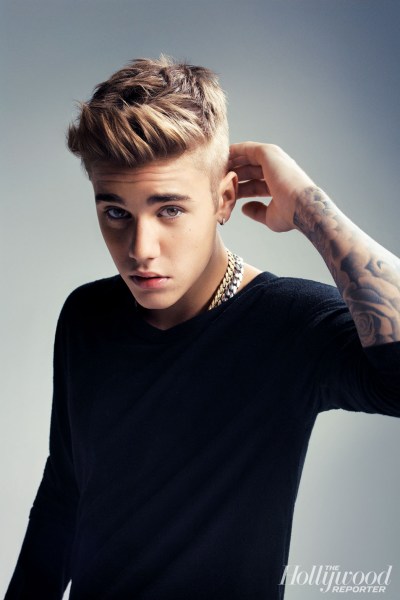
Surprise. An article about the ever-rising superstardom of Canadian not-so-young-anymore heartthrob, Justin Bieber.

It would be foolish of me not to capitalize on Bieber’s explosion in popularity, right?

The artist of the month featured in the month of January is Justin Bieber.

I never thought I'd see the day where I'd willingly save a picture of Justin Bieber onto my computer.

I never thought I’d see the day where I’d willingly save a picture of Justin Bieber onto my computer.

Admittedly, I am not a fan of the man they call Justin Bieber. I don’t really follow his every move like the Beliebers out there, I don’t really listen to his music, nor am I a big fan of his apparent Diva attitude. What I can admit to, however, is that the recent change in his sound has caught the attention of a more grown-up audience, and for good reason as well. Justin Bieber isn’t a boy anymore. He’s a man. And other grown ass men around the world are acknowledging that.

This babyfaced blond was first discovered on YouTube (it seems like every bloody artist nowadays is discovered on YouTube, and here I am tone deaf with no concept of pitch whatsoever). He was soon signed to a record deal and released his first album in 2010, where he recorded typical teeny bopper pop songs like Somebody to Love and the infamous Baby featuring Ludacris. His babyface, my-voice-hasn’t-cracked-yet vocals and typical teenager charm caught the attention of young impressionable girls worldwide, and the Biebs became a hit.

Of course, you can’t possibly be liked by everyone, and as much as Bieber was adored, he was despised by a more mature audience.

Apparently, Bieber didn’t stick to his goody two-shoes image too long, and he chose to go down a more risky path. In 2012, Bieber released his third studio album, Believe. The single As Long As You Love Me featuring Big Sean included a more adult video clip, including scenes of Bieber being beat up by his girlfriend’s disapproving father (I actually laughed at this. I’m a terrible person.) After these more adult-y songs, it would be expected that Bieber would be more well received, right? Well, other than the ridiculously catchy song Boyfriend, adults still didn’t respond well to the Biebs.

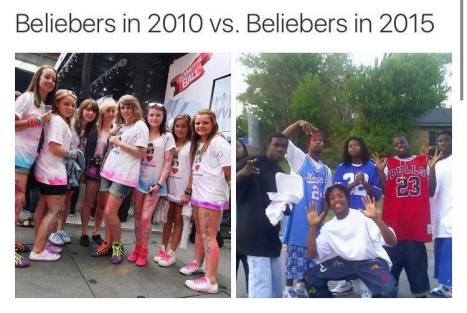
Fast forward to 2016, and now this meme could not be any more accurate.

This is truth.

This is truth.

So what happened in between the release of Believe and today? Bieber’s fourth album, Purpose. The cover art should spell it out for you, really; Bieber isn’t a boy anymore, and he wants to let people know that. This album featured hit after hit after hit, with my most favourite being Sorry, where the video clip features an old family friend New Zealand dance extraordinaire Parris Goebel and her dance crew. Compare Bieber’s first album to his most recent, and you can clearly see the evolution that the Canadian has gone through.

With only four studio albums to his name, it’s surprising that the man has amassed such an empire and mass following, and it doesn’t seem like his popularity is stopping any time soon. I mean, today it was reported that he had dyed his hair purple. Like, this is headline stuff right here. I dyed my hair bright red once, and no one wrote about that… tear.

I acknowledge that Bieber has come a long way since his Bieber-hair days, and does have the talent that warrants this much attention, but I am quite content to sit here listening to Kacey Musgraves tbh. Y’all can have Bieber.

– by The Black Widow

I am not Plastic Fob-tastic

If I had to choose one term that I hate with a fiery passion to abolish, it would be “plastic fob”. Never heard of it? Let me explain.

100% genuine. 0% plastic.

100% genuine. 0% plastic.

To those of you who don’t know me, my cultural background is Maori, Samoan and a dash of Irish in there somewhere. I was born in Australia so I identify myself as being Australian but will never hide my cultural background. I am proud of my pacific roots and embrace my culture – maybe not to its full extent, but I still love and acknowledge where my ancestors have come from.

As I have had a “traditional” Australian upbringing in the beautiful country town of Bathurst, I’m not as cultured as someone who was born and raised in the islands; I don’t know all of the cultural norms and I don’t speak neither fluent Maori or Samoan (not for lack of trying, I have pestered my parents to teach me on numerous occasions). In fact, I speak better Portuguese than I do either of those languages.

Does that make me any less Samoan or Maori than another child of the pacific? No, it doesn’t. As people who are normally stereotyped as easy-going and friendly, why are some Polynesians so bitter towards each other?

This is where “plastic fob” comes in. A plastic fob is, basically, someone who has a cultural background from the Pacific Islands yet doesn’t act or behave like a “normal” Polynesian would. That is what pisses me off. I get this term branded on me by so many of my own people who don’t even take the time to actually get to know me. My best friend, who had a similar upbringing as me and who is half Samoan and half Italian, has the same issue as me; we went through a lot of the exclusions just because we were “plastic”. I know some of my siblings have to deal with this kind of, dare I say, bullshit, as well.

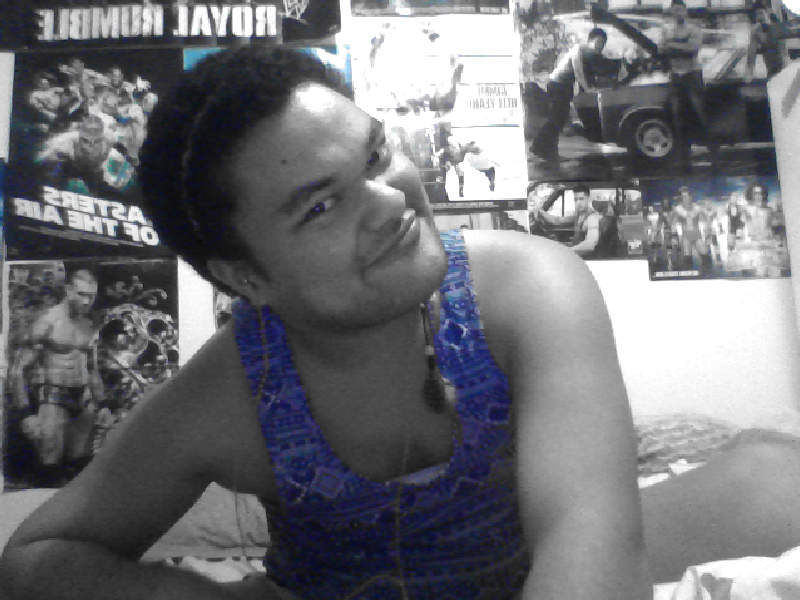
Let me put this on the record: I am not plastic. I am not pretending to be anyone but me. I am who I am. Just because I am not musically gifted in singing or playing acoustic guitar does not make me any less Polynesian than it does the guys from Nesian Mystik. Just because I am not working in some form of security does not make me any less Polynesian than my big brave cousin who does. I haven’t been to neither of the homelands (New Zealand or Samoa just FYI), but you try and put me on a plane and you will see how difficult of a task that is (see attached).

I get judged a lot just because I am a lot different to the “stereotypical” Polynesian man and have been called a “plastic fob” many times in my life and sometimes worse. It’s ridiculous.

Please, my fellow Polynesians, whether you be Samoan, Tongan, Fijian, Niuean or Maori, we need to learn to stick together and not judge one another just because we’ve had a different childhood. One of the things I most enjoy about our culture is how I can bump into someone whom I’ve never met before and still say hello or give a polite nod just because we have that same cultural similarity. We are some of the most beautiful people on the planet so let’s not change that and let’s please abolish the term “plastic fob.” It tells a better story about the insulter than the insultee.

My name is Nikki. I am Maori. I am Samoan. I am Irish. I am a journalist. I am a rugby league enthusiast. I am video gamer. I am a horror movie lover. I am a country head. I am a pole dancing student. I am my own person. I am not plastic.

– by The Black Widow

Sluts vs Players

So I was on the train the other day, casually minding my own business, when I heard a small group of girls a few rows down from where I was sitting (who looked to be in their late teens) talking about a “slut” they knew. Not bothering to keep their voices down – I’m assuming it was because there weren’t many people in the carriage – they gossiped with abandon about how this girl had supposedly been with many guys, and how people had found out and bullied/bad-mouthed her about it.

Now, I know what they were talking about is nothing out of the norm, but what was unsettling was that they seemed to relish the fact that she was being bullied. I won’t elaborate on how the girl was apparently bullied or to what extent, but the fact is that she was, and that these girls felt it was justifiable. At that moment, two things simultaneously popped up in my mind; I suddenly thought of pop artist Lily Allen’s latest single, Hard Out Here (where she sings about the inequality in treatment between promiscuous males and females), and mentally asked myself if these girls would relish or at least relish it as much if a promiscuous male was bullied, or bad-mouthed etc.

Lily Allen has a b***y p***y.

Lily Allen has a b***y p***y.

The answer in my mind was most likely not.

Because judging from other times that I’ve seen or heard people talking about similar matters, such males are only called reasonably offensive names and more often than not, they’re simply regarded as “players”. Whereas with females, the words “slut” and “whore” are often used with a heavy intent to denigrate them, and in some cases, almost make every word or action of hurt that comes their way seem justifiable.

So it’s obvious they earn heavier societal repercussions than their male counterparts do, and that is something I fail to understand. If, for example, both a male and female were to have the same (large) number of sexual partners and/or encounters – and the word “large” is very subjective here – it would most likely be the female who gets degraded and vilified more heavily. Lily Allen candidly sums this up with her lyrics, “If I told you ‘bout my sex life, you’d call me a slut…When boys be talking about their bitches, no one’s making a fuss…”

I know this topic/issue is nothing new, but having seen and heard people slut-shaming (as it is casually referred to) every so often, it’s irritating to see the discrepancy in treatment between both genders – especially when we’re supposed to be living in an era where males and females are equal, in a sense. I mean, I know it’s obvious that religion, culture, society/social norms and upbringing etc influences or helps to shape our views and opinions on these matters but to be honest, it’s simply unjust and demeaning to females, to say the least. Allowing males to do as they please in terms of sexual ventures and having any number of sexual partners without the harsh condemnation sets females back by far – in a way, it’s like restricting a right.

Don’t get me wrong, I’m far from being a misandrist, and I’m not going to inject my own views on promiscuity here either – as it is both unnecessary and irrelevant – nor am I aiming to sway other people’s views on it as it is a quite a complex and subjective matter – for example, people have different opinions on what it means to be promiscuous, or if it’s morally right or wrong etc. But what certainly needs to be pointed out is that in this day and age, females should have more rights than they have had previously, and having the right to be treated as equally as males in terms of sexual ventures and experiences is one of them.

– by Rosemary Nguyen